Pension · Vested benefits · Comparison 2026
Vested benefits account comparison
10 providers compared. Account or portfolio, interest, fees and rules at a glance
 Updated on 13 November 2026 · Reading time approx. 10 minutes · by Helga Baechler, certified wealth advisor IAF
A job change with a gap, a sabbatical, travelling, becoming self-employed or leaving Switzerland. Suddenly you have to decide where your pension fund money goes. Often it is tens of thousands of francs. In my vested benefits account comparison I compared 10 providers, from free accounts to low-cost portfolios.
Which vested benefits account is the best in 2026?
If you need the money within the next one or two years, a fee-free vested benefits account is enough. If it stays invested for five years or longer, a low-cost vested benefits portfolio is usually the better choice. My winner is finpension at 0.49 % per year all-in with up to 99 % shares. Good alternatives are Descartes with up to 100 % shares and VIAC with a free account solution.
My two favourites for vested benefits
 No. 1 · my winner
finpension vested benefits
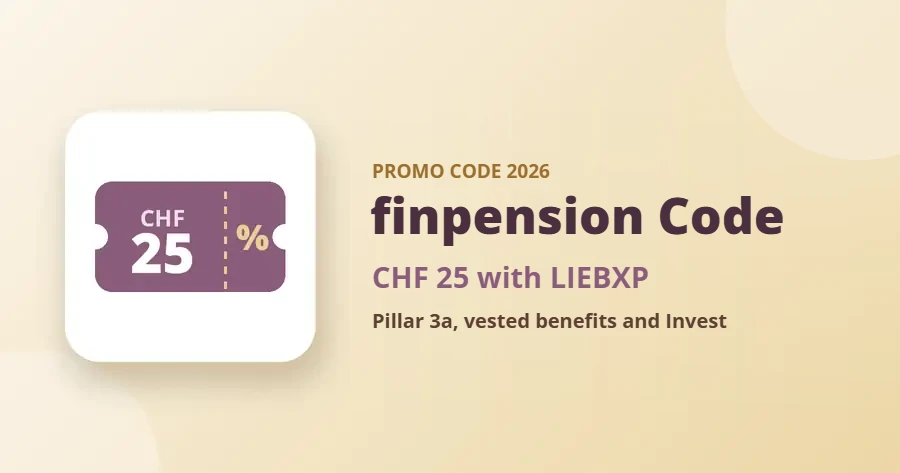
CHF 25Credit towards your fees
- 0.49 % per year all-in, account and portfolio
- Up to 99 % shares, index funds
- No fee for changing your strategy
*Advertising. Enter the code when you open your account. More in my finpension review.
Descartes vested benefits
CHF 50Bonus on the vested benefits account
- 0.64 to 0.80 % all-in, fund costs included
- Up to 100 % shares, Bitcoin also possible
- Independent foundation and custodian bank
*Advertising. Enter the code when you open your account.
What is vested benefits?
When you leave a job and do not start a new one with a pension fund straight away, your pension fund money (2nd pillar) has to go somewhere. In Switzerland it goes to a vested benefits foundation, in German «Freizügigkeit». You can keep it in a simple account or invest it in a portfolio until you join a new pension fund, retire or leave Switzerland.
The best vested benefits providers 2026, my ranking
I rated fees, maximum share of equities, transparency, ease of use and the costs in special cases. Banks offering only an interest account are rated separately in the interest section.
- finpension vested benefits0.49 % all-in, up to 99 % shares, account and portfolio in one app★ 4.8 / 5
- Descartes vested benefits0.64 to 0.80 % truly all-in, up to 100 % shares, CHF 50 bonus★ 4.5 / 5
- VIAC vested benefitsManagement fee max. 0.40 %, free account solution, up to 99 % shares★ 4.5 / 5
- frankly vested benefits (ZKB)0.44 % all-in on securities, max. 75 % shares★ 4.1 / 5
- Tellco vested benefitsFree account, funds approx. 0.40 to 0.72 %, up to 85 % shares★ 3.8 / 5
- Liberty vested benefitsapprox. 0.68 % total, up to 95 % shares, cash free of charge★ 3.7 / 5
My own rating, as of November 2026. Not investment advice.
Vested benefits account or vested benefits portfolio?
A vested benefits account is a savings account for your pension fund money. Safe, but with almost no interest. In a vested benefits portfolio your money is invested in funds. It fluctuates, but has much better return potential over the long term. What matters most is how long the money stays there.
| Vested benefits account | Vested benefits portfolio | |
|---|---|---|
| Return | 0 to 0.5 % interest | Much more over the long term, but fluctuating |
| Risk | No market risk | Price losses possible |
| Costs | Mostly free, sometimes up to CHF 36 per year | Approx. 0.4 to 0.8 % per year with digital providers |
| Suits | Short horizon, buying a home soon | Horizon of approx. 5 years or more |
Good to know
If you find a new job with a pension fund, you generally have to transfer your vested benefits there. A portfolio is therefore mainly worth it if you will not have a new pension fund for a longer time.
Vested benefits portfolio comparison 2026
With a portfolio, fees matter most. Half a percent more or less quickly adds up to a five-figure amount over many years.
| Provider | Fee per year | Max. shares | Cash and account | Bonus |
|---|---|---|---|---|
| 1. finpension | 0.49 % all-in | 99 % | 0.49 % also on cash | CHF 25 with LIEBXP |
| 2. Descartes | 0.64 to 0.80 % all-in | 100 % | All-in on the portfolio | CHF 50 with liebefinanzen |
| 3. VIAC | Management max. 0.40 %, total under 0.44 % | 99 % | Free account solution, 0.05 % interest | – |
| 4. frankly (ZKB) | 0.44 % all-in on securities | 75 % | No all-in fee on cash | – |
| 5. Tellco | approx. 0.40 to 0.72 % (fund TER) | 85 % | Free account solution | – |
| 6. Liberty | approx. 0.68 % total | 95 % | No fee on cash | – |
| Bank with pension funds | often 0.9 to 1.2 % and more | depends on the bank | depends on the bank | – |
As of November 2026. finpension according to its fee schedule (valid from 1 July 2026), VIAC according to its fee FAQ, Tellco according to its cost regulations, others according to provider information and my own research. With VIAC, fund costs, stamp duty and currency costs may be added depending on the strategy, with frankly the funds’ issue and redemption fees. No guarantee.
Why finpension is my number one
- One number, everything included. 0.49 % including custody, transactions and strategy changes.
- Up to 99 % shares. Ideal if the money stays invested for a long time.
- Transparent index funds. Global, sustainable or with a Swiss focus.
- Account and portfolio in one app. Also perfect for splitting between two foundations.
On paper, VIAC and frankly are slightly cheaper on the base fee. But depending on the strategy, further costs are added there. If you want to park money as cash for a while, VIAC is the smarter choice thanks to its free account solution.
Vested benefits fees in a chart
Fees per year in a vested benefits portfolio
As a percentage of your balance, with a high share of equities. In brackets the cost per year on CHF 100’000.
Tellco and Descartes shown as the middle of their range. With VIAC and frankly further costs may be added, with finpension and Descartes they are included.
Vested benefits account interest rates 2026
With a pure account, interest rates in 2026 are almost zero. The Substitute Occupational Benefit Institution (Stiftung Auffangeinrichtung BVG) cut its rate from 0.40 % to 0.05 % on 1 January 2026. At the banks, the average at the beginning of 2026 was approx. 0.08 %.
| Provider | Interest | Account fee | Note |
|---|---|---|---|
| PensionClub (Liberty) | 0.41 % | Free | Free association membership required |
| Pilla (Liberty) | 0.30 % | Free | Online |
| Raiffeisen | 0.05 % | Free | Depends on the Raiffeisen bank |
| VIAC account solution | 0.05 % | Free | Via app |
| Substitute Occupational Benefit Institution | 0.05 % | Free | Where your money ends up if you do nothing |
| Glarner Kantonalbank | 0.05 % | CHF 36 per year | Swisscanto vested benefits foundation |
| UBS | 0.01 % | CHF 36 per year | CHF 3 per month |
| PostFinance | 0.00 % | depends on residence | Account solution without interest |
Interest according to providers and comparison sites, as of October and November 2026. Rates can change at any time.
- Fees beat interest. With a CHF 36 account fee and 0.05 % interest, you make a small loss on CHF 50’000.
- Inflation. If the money stays in the account for longer, you lose purchasing power in real terms.
- Check the foundation. Several offers lead to the same foundation, only the interest rate differs.
Vested benefits account vs. portfolio over 20 years
How CHF 100’000 of vested benefits develops
Assuming a 5 % return per year before fees, without further deposits. Not a forecast.
The difference is huge. After 20 years, in this example the low-cost portfolio holds approx. CHF 140’000 more than the account. Compared with an expensive bank fund it is still approx. CHF 30’000 more, just because of the lower fees.
Vested benefits calculator · account or portfolio?
CHF 80’000
15 years
5 % per year
Simplified model without further deposits. Account at 0.05 % interest, portfolios at the chosen return minus fees. Markets fluctuate, losses are possible. Not a forecast and not investment advice.
All vested benefits providers in detail
1. finpension vested benefits, my winner
finpension uses index funds and charges a flat 0.49 % per year for the account and index strategies. Strategy changes, custody and transactions are included. You can invest up to 99 % in shares, globally, sustainably or with a Swiss focus.
- Everything included. One fee, no hidden transaction costs.
- High share of equities. Up to 99 %, ideal for a long investment horizon.
- Good for splitting. As one of two vested benefits accounts for staggered withdrawals.
- Fee also on cash. finpension is too expensive just for parking money.
- Special fees. Early withdrawal for a home CHF 500, withdrawal when living abroad also CHF 500.
More in my finpension review. The code LIEBXP is above, all details on my finpension promo code page.
2. Descartes vested benefits
Descartes is an independent asset manager from Zurich with a FINMA licence. For vested benefits you pay 0.64 to 0.80 % per year all-in. Fund costs, currency fees, transaction costs and issue surcharges are already included. Since May 2026 up to 100 % shares are possible again, and since 2026 also Bitcoin.
- Truly all-in. No TER on top.
- Independent. No own funds and no products from the custodian bank.
- CHF 50 bonus. With my code liebefinanzen on the vested benefits account.
- More expensive than finpension. Especially for the low-risk strategies.
- No native app. Descartes runs as a web app.
3. VIAC vested benefits
VIAC belongs to WIR Bank. The management fee only applies to the invested part and is capped at 0.40 % per year. The pure account solution is free and pays 0.05 % interest.
- Free account solution. Perfect for parking money for a short time.
- Fee cap. Max. 0.40 % management fee, total under 0.44 % when fully invested.
- Not quite everything included. Depending on the strategy, fund costs and currency exchange costs are added.
How VIAC compares with finpension is in VIAC vs finpension vs Frankly.
4. frankly vested benefits (ZKB)
frankly is the digital pension solution of Zürcher Kantonalbank. For vested benefits there is an account solution with interest and four strategies with 15 to 75 % shares. The all-in fee is 0.44 % on securities and does not apply to cash.
- A big bank behind it. For everyone who wants a cantonal bank.
- Simple. A few clearly defined strategies.
- Max. 75 % shares. Rather low for a very long horizon.
- Active funds. Issue and redemption fees are not included in the all-in fee.
5. Tellco vested benefits
Tellco from Schwyz offers a free account solution and a digital securities solution. With the Tellco Classic funds there is no custody fee, you only pay the fund costs of approx. 0.40 to 0.72 % per year. Up to 85 % shares are possible.
- Free account. No costs for opening, managing or closing.
- Large choice of funds. Thematic and third-party funds also possible.
- Third-party funds cost extra. Additional custody fees apply to thematic and third-party funds.
6. Liberty vested benefits
Liberty is one of the large independent vested benefits providers, based in Schwyz. With the index fund strategy up to 95 % shares are possible, and total costs are approx. 0.68 % per year. Cash stays free of charge. Solid, but more expensive than finpension and VIAC.
Banks and the Substitute Occupational Benefit Institution
Raiffeisen, UBS, PostFinance, cantonal banks and the Substitute Occupational Benefit Institution are safe and simple. As an account, however, they pay almost no interest in 2026, and some even charge an account fee. Their pension funds are usually much more expensive than the digital providers. For a few months that is fine, for many years it costs you a lot of money.
Keeping an eye on it
True Wealth founded its own vested benefits foundation in August 2026. As soon as the offer is available with all fees, I will add it to the comparison.
Which vested benefits provider suits you?
| Your situation | Best fit |
|---|---|
| Long horizon, maximum return | finpension |
| Everything included, up to 100 % shares, also Bitcoin | Descartes |
| Park money for free for a short time | VIAC account solution |
| A cantonal bank behind it, few shares | frankly |
| Highest account interest without a portfolio | PensionClub or Pilla |
| Large amount, staggered withdrawal | Two foundations, for example finpension and Descartes |
Leaving Switzerland? What happens to your vested benefits
Many expats move on after a few years. Whether you can take your pension fund money with you depends on where you move to.
- Moving outside the EU and EFTA (for example to the UK, the USA, Canada, Australia or Asia): you can usually withdraw your entire vested benefits in cash.
- Moving to an EU or EFTA country: only the extra-mandatory part is paid out straight away. The mandatory part usually stays in Switzerland, for example in a vested benefits account, until retirement age or another reason for withdrawal.
- Taxes: the payout is taxed at source in Switzerland. The rate depends on the canton of your foundation, which is why many expats compare foundations in low-tax cantons. Under a double taxation agreement you may be able to reclaim the tax.
- Fees: check the fee for withdrawal when living abroad, it differs a lot between providers (see special fees).
If part of your money has to stay in Switzerland, a low-cost portfolio can let it keep growing until you retire. More about your pillar 3a when leaving is in pillar 3a for expats.
Special fees compared
Besides the annual fee, it is worth looking at the fees in special cases. They can cost more than several years of interest.
| Case | finpension | VIAC | Tellco | Liberty offers |
|---|---|---|---|---|
| Early withdrawal for a home | CHF 500 | CHF 300 | CHF 400 | CHF 400 |
| Withdrawal when self-employed | – | – | CHF 200 | CHF 250 |
| Withdrawal when living abroad | CHF 500, in the first year CHF 3’000 plus 1 % | no fee | CHF 600 | CHF 600 to 1’200 |
| Pledging | CHF 200 | according to regulations | according to regulations | according to regulations |
| Strategy change | free | free | free | free |
finpension according to its fee schedule valid from 1 July 2026, others according to provider information and comparison sites. «–» means I found no separate fee. Please check the current regulations before any withdrawal.
The splitting trick, two foundations for lower taxes
When you leave your pension fund, you may split your balance between a maximum of two vested benefits institutions. This is mainly worth it for larger amounts.
- Staggered withdrawals. You withdraw the two accounts in different years and so break the tax progression.
- Account and portfolio. One part safe in the account, one part invested in a portfolio.
- Only when leaving. It is best to split right at the change, later it is more difficult.
The most important vested benefits rules 2026
- Deadline. If you do not give your pension fund payment instructions, it transfers the money to the Substitute Occupational Benefit Institution after 6 months at the earliest and 2 years at the latest.
- Withdrawal. At the earliest 5 years before the reference age. Postponing it, up to age 70 at most, is only possible if you keep working.
- Home ownership. Early withdrawal from CHF 20’000, at most every 5 years and up to 3 years before the reference age.
- Self-employment. If you become self-employed as your main occupation, you can have the balance paid out in cash.
- Emigrating. Outside the EU and EFTA you can withdraw everything. In the EU and EFTA only the extra-mandatory part is available straight away.
- Taxes. As long as the money is in vested benefits, you pay no wealth tax and no income tax on it. On withdrawal it is taxed separately at a lower rate.
How to open your vested benefits account in 4 steps
Choose account or portfolio. Depending on how long the money stays there. Use the traffic light above.
Open online. With finpension, Descartes, VIAC or frankly this takes approx. 15 minutes with your ID or passport.
Inform your pension fund. Send your old pension fund the account details of the new foundation. If you want to split, give both foundations and the split right away.
Choose a strategy. As soon as the money arrives, it is invested according to your strategy. After that you can leave it.
Checklist for your vested benefits account
- Time horizon clear, account or portfolio?
- Total costs per year compared, not just the base fee
- Share of equities chosen to match your horizon
- Special fees for home ownership and living abroad checked
- Larger amounts split between two foundations
- Pension fund informed in time, before the money goes to the Substitute Occupational Benefit Institution
- Bonus code entered when opening
Already at the Substitute Occupational Benefit Institution or a bank?
No problem. You can transfer your balance to another provider at any time. Simply open the new account, the transfer is requested there.
Frequently asked questions about vested benefits accounts
Which vested benefits account is the best in 2026?
For a short time, a fee-free account solution makes sense. For five years or more, a low-cost vested benefits portfolio is usually better. My winner is finpension at 0.49 % all-in and up to 99 % shares, followed by Descartes and VIAC.
What is the difference between a vested benefits account and a vested benefits portfolio?
In a vested benefits account your money sits in a savings account with interest. In a vested benefits portfolio it is invested in funds. The portfolio fluctuates, but has much higher return potential over the long term.
Where is the highest interest on a vested benefits account?
According to comparison sites, PensionClub at 0.41 % and Pilla at 0.30 % offered the highest rates in autumn 2026. Both lead to the Liberty vested benefits foundation. Most banks pay 0.05 % or less.
What interest does the Substitute Occupational Benefit Institution pay in 2026?
Since 1 January 2026 it pays only 0.05 %, before it was 0.40 %.
How many vested benefits accounts can I have?
When you leave a pension fund, you may split your balance between a maximum of two vested benefits institutions. This lets you withdraw in stages later and save taxes.
What happens if I do nothing?
Then your pension fund transfers the money to the Substitute Occupational Benefit Institution after 6 months at the earliest and 2 years at the latest. It is safe there, but only earns 0.05 % interest in 2026.
Can I switch my vested benefits account?
Yes, a transfer to another vested benefits foundation is possible at any time. You open the new account and request the transfer there. Watch out for any exit fees at your old provider.
Is a vested benefits portfolio worth it?
If the money stays invested for five years or longer, usually yes. In my example with CHF 100’000 and a 5 % return before fees, the low-cost portfolio holds approx. CHF 140’000 more than the account after 20 years. This is not guaranteed.
Do I have to pay tax on my vested benefits?
Not as long as the money stays in vested benefits. Only on withdrawal is it taxed as a capital benefit, separately from your other income and at a lower rate.
When can I withdraw my vested benefits?
At the earliest 5 years before the reference age. Earlier only in special cases, for example for a home, when becoming self-employed as your main occupation or when leaving Switzerland for good.
Can I withdraw my vested benefits when I leave Switzerland?
If you move outside the EU and EFTA, usually yes, in full. If you move to an EU or EFTA country, only the extra-mandatory part is paid out straight away, the mandatory part usually stays in Switzerland.
Is my money in a vested benefits portfolio safe?
Vested benefits invested in funds are protected as segregated assets, even if the bank goes bankrupt. But prices can fluctuate and losses are possible.
Conclusion
For a few months a free account is enough. If your vested benefits stay there longer, a low-cost portfolio is worth it. My number one is finpension, Descartes fits if you really want everything included and up to 100 % shares. VIAC is the best choice if you want to park money for free for a while. And split larger amounts between two foundations, it saves taxes later.
Read more
*Advertising, affiliate links and codes. This article is for general information only and is not investment or tax advice. Fees and interest rates as of November 2026, no guarantee.